Saturday, January 26, 2013
Inventory of a Carpet Factory in 1842
Amsterdam, on the Mohawk River, Montgomery County, in central New York, began as a textile factory town with impetus from two families. By 1840, William K. Greene, of Poughkeepsie, had set up a carpet factory with his son, William K. Greene, Jr. In 1842, the Greenes formed a partnership with John Sanford. William K. Greene and Son conveyed the factory building and all contents to the partnership of Sanford & Greene.
Both William K. Greene Sr. (1790-1864) and John Sanford (1803-1857) came to NY from Connecticut. Greene was born in Leicester, MA, but married in Woodstock, Windham County, where his first few children were born. Since ingrain carpet weaving was being done in Connecticut by 1823, this may be where he picked up some knowledge of textile operations. Sanford was born in Roxbury, Litchfield County, and is reported in a biographical sketch to have come to Amsterdam in the 1830s as a teacher.
While a recorded partnership agreement has not been found, deeds recorded in Montgomery County in August and October, 1843 reflect sale of the Greene property on Market Street, on the West side of Chuctanunda Creek, to Sanford as well as joint purchase of two adjacent properties and water rights of what had been a plane factory. These were adjacent to the existing dam and pond on Chuctanunda Creek, which had already furnished power to grist mills, oil mills, an iron forge, sawmills and a fulling mill.
In 1845 the factory in Amsterdam was reported producing 600 yards of carpeting per day, selling at 75 or 80 cents per yard, “and arrangements are making for the manufacture of three ply and Brussels qualities” [New York Herald, May 7, 1845, page 1, and other papers around this date]. The partnership is also reflected in the inventory that follows, but it may have been short-lived. By a deed of April, 1847, the Greenes sold to John Sanford a lot known as part of the “forge lot” together with building, equipment and stores, reserving to themselves the water wheel on the premises which they intended to remove. In late 1847 William K. Greene, Jr. was designated agent and superintendent of a new carpet mill in Schenectady, which was to have a dye house and separate building for the 40-horse steam engine that was to power the looms [The Cabinet (Schenectady, NY), November 2, 18347, page 2].
Shortly before midnight, December 20, 1849, a fire started in the Sanford carpet works’ yarn-drying area, destroying the wood building, 50 looms, two sets of cards and other machinery, although some carpet, wool and dye stuffs were spared [Albany Evening Journal (Albany, NY), Saturday, December 22, 1849, page 2]. John Sanford’s son, Stephen, rebuilt upstream on the same creek, and this factory and its merged corporate organizations operated for many decades there.
The following inventory is in a ledger, identified on the flyleaf as Sanford & Greenes Invoice Book. It reflects the equipment and materials used by producers of ingrain carpet as well as “fancy” coverlets, although the types of yarns used in coverlets would vary and not all coverlet producers were dyers as well.
Sanford & Greenes Invoice Book
Invoice of Machinery, Building, Stock &c Bo’t. of Wm. K. Green & Son
by Sanford & Greene’s Aug’t. 14, 1843
1 Factory Building at 350.00 350.00
10 Carpet Looms camptute @ 125.00 1250.00
1 Warping Mill & Creele 10.00
5 Set. Wheels & Swifts @ 4.00 20.00
8-3/4 doz Shuttles $5.00 43.75
10 pr Temples @ 4/ 5.00
1238 Bobbins 8/ pr 100 12.38
232 Spools @ $6. pr 100 13.92
1 Cloth Prep Screen & Bar 40.00
1 Shearing Machine 115.00
1 Rolling Machine 5.00
1 Burling Table 2.00
1 Beaming Apperatus 2.00
2 Raddles @ 10/ 2.50
1 Set Plates & Puncher 20.00
1 Card Lacing Machine &c 2.00
2 Sets Old Vine Pattern & Design 1250 cards @ $15. 30.00
4 “ New do. “ 418 $5 20.00
4 “ Boquet “ 480 $7 28.00
3 “ Calico “ 380 $3 9.00
1 “ Flour Pot “ 680 111 10.00
2 “ Star “ 480 4.00 8.00
1 “ C. M. P. “ 241 3.00
1 do “ ” 3.00
1 “ D. &c. Fora “ 480 8.00
1 Dye Kettle Copper Large 110.00
1 do do Small & Tub &c 100.00
1 Soap Vat 5.00
1 Indigo Grinder 3.00
1 Trunk for Keeping Design’s 2.00
2 Set Scroll Pattern & Design 630 Cards each @ $8 16.00
59 # Smyrna Yarn in Greese @ 22 12.90
62 “ do do “ 13.64
40 “ do do “ 8.80
51 “ Codover do 24 12.24
317½ “ do 1 Bale 4/ “ 76.70
153½ “ do “ 36.84
29 “ Lot’s custom (?) Yarn 60 17.40
140 “ do Smyrna “ 30 42.00
28 “ do in Greese 22 6.16
72 “ Codover Col’d 32 23.04
73 “ do in Greese 24 17.52
75 “ Chelmsford B in “ 18 13.50
75 “ do do Col’d. 26 19.50
5 “ Worsted in Greese 45 2.25
64 “ Chelmsford B. Col’d 26 16.64
90 “ do do “ 23.40
66 “ do do “ 17.16
46 “ do do “ 11.96
14 “ N. E. B 4/8 do 29 4.06
72 “ Smyrna do 30 21.60
79 “ Whinfield do 29 22.90
7 “ Custom do 60 4.20
25 “ Chelmsford B “ 26 6.50
25 “ do in Greese 18 4.50
50 “ do do 18 9.00
50 “ do Col’d 26 13.00
50 “ Worsted in Greese 45 22.50
50 “ do Col’d 55½ 27.75
27 “ N. E. B. filling 29 7.83
28 “ do in Greese 22 6.16
1 Black Haun 4.00
3½ # Worsted in Greese 45 1.58
40 “ filling on Bobbins N E B 29 11.60
2 lots in Loom not commenced (?) @ 19 38.00
1 “ do on Warping Mill 19.00
5 “ in Looms commenced (?) Equal to 3 pr @19 57.00
101 # Worsted on Spools 55½ 56.05
62 “ do Col’d 55½ 34.41
89 “ do do “ 49.40
18 “ N. E filling do 29 5.22
60 “ Chelmsford B do 26 15.60
70 “ do do do “ 18.20
68 “ do do do “ 17.68
80 “ Smyrna do 30 24.00
19 “ Codover do 32 6.08
34 “ Chelmsford B. do 26 8.84
76¾ “ Custom do 40 46.05
5½ Cords Wood @ 14/ 9.63
2 Stoves & Pipes 10.00
2 Willow Baskets 2.50
1 Screw Wrench 2.00
2 pr Plyers@ 3/ .75
1 Hammer 3/ .38
2 Bbls 2/- Hyper 182, 177 359 3¾ 13.96
1 “ ” Fustick 115 1¾ 2.27
3 C. 2/ Logwood 346 @ 2 7.67
1 St. do 114 1½ 1.96
2 Bark 323 1¾ 6.16
1 Allum 290 3¼ 9.67
1 Hyper 82 3¾ 3.32
1 Fustick 57 1¾ 1.24
1 Bark 28 2/ 2 .81
1 Keg Lack Dye 2/ 29 4.31
1 “ Blue Vitrol 33. 10 3.55
1 Bbl Whiting 33 1½ .75
½ “ 2/ Red Tarter 100 lbs 13 13.25
1 Bbl 2/ Logwood 36# 2 .97
1 Bbl Brimstone 96 “ 2 1.92
5 # C. Tarter 22 1.10
1 Carboy 12/ M. Anice 100 # 4 5.50
1 “ Oil Vitrol 96 12/ 3½ 4.86
1 “ Aquafortis 58 1/ 8.75
24 # B. Tin Grain’d 2/ 6.00
60 “ M. Anice 4 2.40
7 Stone Pots 5/ 4.38
1 Coffee Mill 8/ 1.00
6 # Cochineal 113 6.78
5 “ do “ 5.60
5 “ G. Indigo 14/ 8.75
1 Hydromiter 4/ .50
1 Bbl Soap 16 2.00
1 Carboy 12/ 1.50
200 # Soap Greese 4 8.00
1 Wheele Barrow 5.00
1¼ Cord Wood 14/ 2.19
32 Dying Palls 8 2.56
3 Pails .38
1 Rinse Box 1.50
1 Box Stove 5.00
1 pr Small Steel Yards 1.00
1 pr Balances 5.00
1 Saw & 1 Axe 1.50
1 Gross Large Pastboard for Carder 16.00
23 # fustick 1¾ .40
19 “ Logwood 2 .38
46 “ Copperas & Keg 2 .80
18 “ Hyper 3¾ .67
6 “ Red Tarter 13 .78
9½ Blue Vitrol 10 .95
13 oz Knot Cord @ 11/# .81
½ # Knot Cord @ 9/ .56
1 Remnant Brussells Carpet 2.25
1 do Ingrain do 1.13
12 Sheets Design paper 1/ 1.50
1 New Design Not Cut 5.00
2¾ Cords Wood @ 14/ 4.81
57 # Worsted Col’d 55½ 31.64
1 of Wimples Patent Scales 20.00
1 Tin Oil Can 35 Gall 3.50
Wm. Partridge Bill Dye Stuf Aug 10. 1843 as on file 35.90
Policy of Insurance 3-1/6 **Leves to sum $1000
Sum p’d Original $16.50 Transf’d 10.45
===========================
$3509.02
Deduct the Am’t. Contributed
by Wm. K. Green & Wm. K. Green Jr.
as Capitall Stock 3000.00
due Wm. K. Green & son $509.02
Rec’d Note at 90 days in full of the above
balance Dec. 30th 1843
Wm. K. Greene & Son
Labels:
Amsterdam,
carpet factory,
dyes,
dyestuffs,
ingrain carpet,
John Sanford,
loom,
weaving,
William K. Greene,
yarn
Monday, January 9, 2012
NMAC Coverlet Query: 8-Point Stars, Long Island Type?
This coverlet may be in the National Museum of the American Coverlet, Bedford, Pennsylvania. I have an ongoing interest in multiple-harness doublecloth coverlets with various sorts of 8-pointed stars and related motifs, particularly those with inscriptions.

If it is not in the NMAC, where is it?
Does this one have an inscription?
❁ ✸ ❁ ✸ ❁ ✸ ❁ ✸
Update: According to Ms. Melinda Zongor, this coverlet is in the collection of the National Museum of the American Coverlet, Accession No. 2007.001.025.
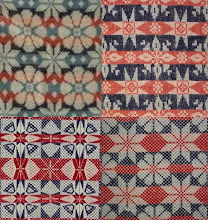
Its motifs are 8-point stars within 6-block snowballs, halves of which are shown in the illustration here, alternating with 8-point blazing stars within which are small stars with tiny diamond checkerboards within them.
The coverlet has no woven inscription, and the donors to the NMAC had no information on its prior ownership provenance.
Many thanks to Ms. Zongor for the information.
The coverlet's motif format strongly resembles some with Long Island provenance woven in the 1820s, and may be a product of the same shop. If this conclusion is correct, the coverlet tells us that the weaver of these geometric-design Long Island coverlets wove coverlets both with and without inscriptions, so some were made for specific clients and others perhaps woven as general stock.
Some Dating Mileposts
Many coverlet owners have wrestled with identifying some features of coverlets. The most difficult area is what sort of loom technologies were used to produce specific coverlets before 1840. Scholars have rightly pointed out that the coverlet itself cannot always answer this question.
So far the history of actual use of specific types of weaver-controlled or automated patterning mechanisms for extensive inscriptions and pictorial patterns in America has not been comprehensively documented. Articles by Virginia Parslow Partridge and Rita J. Adrosko, in Made In New York State remain the best surveys of this topic, although research continues.
It has been said that the Jacquard-type mechanism was mainly installed on handlooms, although this can’t be determined by looking at coverlets. Power from a water wheel or steam engine was widely possible by the last quarter of the 18th century. Factory-spun cotton yarns introduced before 1800 made power looms much more workable. Tied weave structures (such as summer-and-winter and those called ‘beiderwand’) and patterns with many small figures in doublecloth also deterred warp stretching and eased using power looms.
A few pictorial coverlets exist in some twill structures, which also would make for a more consistent shed. One brought to my attention dated 1833, by J. Hausman, looks to be in a summer-winter structure with an unusual interlacement. If these were as uncommonly woven as it now appears, I’d like to be able to ask the producers why they used these structures at all.
Woven dates have their own uncertainties. They could commemorate a client’s date of birth or marriage rather than the date woven. Of the geometric-design coverlets, some inscriptions appear to have been produced by a loom-control means; others were inlaid on the loom in a “pickup” method. Since photographs have limitations, it is not always obvious whether some might have been embroidered.
The year 1831 saw an explosion of weavers’ advertisements and pictorial coverlets– an explanation for this has not been documented.
While many coverlet weavers can be found in pre-1831 tax assessment rolls, such as Jacob Bender in Westmoreland County, Pennsylvania in 1826, they are not included here. Despite the questions, a look at chronology reflected in coverlets and advertisements gives one picture of trends.
GEOMETRIC-PATTERN COVERLETS: WOVEN INSCRIPTIONS AND EARLY ADS
Our most commonly seen are four-harness overshot coverlets, with their astonishing variety in design. The earliest known woven dates are 1771 and 1773, and the latest I know of is 1846. “Tied Beiderwand,” multiple-harness overshot coverlets of the “starwork” type and of the type with other twill-like designs (and sometimes tulips, trees and men) are not known with dates. Rare coverlets in structures such as boundweave and “M’s and O’s,” have not been found with woven-in dates.
Summer-and-winter coverlets are less commonly found, and of those few with woven dates the earliest I have seen is 1817 and the latest 1848.
Multiple-harness free plain doublecloth coverlets with geometric patterns, bearing dates, names and other inscriptions from Long Island, New York, are now famous, thanks to the work of Susan Rabbit Goody. The earliest known date on these is 1810, and the latest I know of, of this type, is 1831. Here again, the dates may reflect birth dates or marriage dates rather than when woven. A few others share the Long Island inscriptions’ format as being woven to read warp-wise in one border, but differ in method and their provenance is unknown; one shown below reads “JANU Y 1 1828” in one loom width's end border, and “H OAKLEY” in the other loom width's border.
Another small group,
with names only, again woven to read warp-wise, may have originated in Westchester County, New York (related-pattern coverlets with no inscription also are known). The names on known examples are M. Ferris, Sally Baker, Eliza Townsend, E. Moseman, Sarah Smith and H. Fowler. Clusters of related families lived on Long Island and in Westchester, so this design format may have a common origin in one or a group of weavers. While their dating may be contemporaneous with those dated in the 1820s or earlier, their time of production has not yet been documented.
Selected ads, weaving coverlets [c]; weaving carpet,
coverlets and/or carpet coverlets [cc]
Oct. 28, 1737 John Ewan, Philadelphia, Philadelphia County, PA [c]
March 3, 1775 Stephen Miner, Stonington, New London County, CT [c]
Oct. 23, 1790 Frederick Baugh, Philadelphia, Philadelphia County, PA [c]
July 15, 1793 Nicholas Mayer, Northern Liberties, Philadelphia County, PA [c]
Sep. 22, 1795 Thomas Brysland, Carlisle, Cumberland County, Pennsylvania [c] Selling lot on Bedford St., Carlisle with log house, log stable and brick weavers shop; will also sell farming utensils, household goods and two Weavers Looms for raised work. For terms apply to owner living on the premises.
Nov. 18, 1795 Robert McBride, Cotton Factory in Carlisle, Cumberland County, Pennsylvania [c] wanted Journeyman Weaver, who can weave with a flying shuttle. Purchased loom, for raised work, from Mr. Thomas Brysland, of whom he received instruction for weaving double and single Coverlids, Diaper and White Counterpains
Aug. 3, 1796 William Dawson, Carlisle, Cumberland County, PA [c]
June 13, 1797 Thomas Thompson, Blooming Grove, Orange County, NY [cc]
July 18, 1797 Joseph Schrack, Fancy Weaver, Berks County, PA [c]
Oct. 26, 1797 Joseph Cherry, White Plains, Westchester County, NY [cc]
April 25, 1799 Henry Arnold, Hagerstown, Washington County, MD [cc]
Dec. 30, 1799 Gawin I. Beatty, Harrisburg, Dauphin County, PA [c]
Nov. 3, 1801 John L. Cole, Bridgetown, Middlesex County, NJ [c] offered to teach diaper and spread weaving up to 20 harnesses
Aug. 7, 1802 Jacob Garlick, Philadelphia County, PA [c] located near Foundry on the Schuylkill
Jan. 29, 1803 Nicholas Mayer, Philadelphia County, PA, moved to Second St. in new Union Row [c]
March 30, 1803 Robert Douglass, Hagerstown, Washington County, Maryland [cc]
Sep. 10, 1803 Hugh McGonnigal, near Fort Fayette, Allegheny County, PA [c]
July 18, 1804 Adam Maguire, Nashville, Davidson County, TN [c]
Oct. 31, 1804 Thomas Garrett, Hagerstown, Washington County, MD [cc]
April 9, 1805 John Bantz, Frederick Town, Frederick County, MD [cc]
Aug 13, 1805 John Philip Schneider, Frederick County, MD [c]
March 21, 1806 James Armstrong, Carlisle, Cumberland County, PA [c]
April 29, 1808 William Morrow, Charlestown, Jefferson County, (West) VA [c]
March 5, 1810 Abel English, Burlington, Burlington County, NJ [c]
March 27, 1810 John Knight, Galway, Saratoga County, NY [cc]
April 3, 1810 Daniel Stover, Mercersburg, Franklin County, PA [cc]
Jan. 2, 1811 Jacob Miller, near Sharpsburg, Washington County, MD [cc]
June 10, 1811 Archibald McCann, Washington Borough, Washington County, PA [cc] new shop one door below his former residence, Wheeling street
Nov. 18, 1811 Archibald McCann, Washington Borough, Washington County, PA [cc] wants Journeyman for coverlet, carpeting and diaper work
Sep. 4, 1811 James Strong, Marsh Creek, Adams County, PA [c]
Dec. 16, 1811 James Burns, Canton Twp., Washington County, PA [c] reward for return of runaway coverlet and diaper weaving apprentice
May 18, 1812 Thomas Miller & Co. Factory, Chillicothe,, Ross County, OH [cc]
July 18, 1812 John Robertson, Ross County, OH [c]
Oct. 21, 1812 Walter Potts, Level Corner, Lycoming County, PA [c]
Sep. 27, 1813 Coverlet and Diaper Weavers, Washington County, PA [c] Met September 11 to set prices. Signers: Thomas Briceland, Wm. Herron, Wm. Robinson, Robert Ford, David Briceland, Arch’d McCann
Oct. 4, 1813 William Robinson, Washington Borough, Washington County, PA [c]
Nov. 24, 1813 Crumpton & Smith, Chillicothe, Ross County, OH [c]
Feb. 2, 1814 John Lamon, Charlestown, Jefferson County, (West) VA [cc]
Sep. 23, 1814 William Long, near Shippensburg, Cumberland County, PA [c]
Oct. 17, 1814 Archibald McCann, Washington Borough, Washington County, PA [c]
Mar. 27, 1815 Archibald McCann, Washington Borough, Washington County, PA [c] All patterns of Coverlet and Diaper done in America, shall be wrought here on a sample being furnished. At his old shop in Wheeling street; now determined not to go volunteering, until his adopted country require his services as a soldier
July 31, 1815 Fred Imhoff, near Washington Borough, Washington County, PA [c]
Oct. 18, 1815 Charles Coburn, near Ballston Springs, Saratoga County, NY [cc]
Nov. 20, 1815 Archibald McCann, Washington Borough, Washington County, PA [c]
Feb. 2, 1816 John Lamon, Charlestown, Jefferson County, (West) VA [cc]
April 1, 1816 William Robinson, Washington County, PA [c] Figured Weaving
April 29, 1816 Archibald McCann, Washington Borough, Washington County, PA [c] at old shop on Wheeling Street
April 29, 1816 John Boal, Washington Borough, Washington County, PA [c] began business in Archibald McCann’s former shop, April 1
June 3, 1816 John Glaze, Mercersburg, Franklin County, PA [c]
April 2, 1817 John Wimmer, Charlestown, Jefferson County, (West) VA [c]
April 21, 1817 James and Robert McMillen, Washington Borough, Washington County, PA [c] in the shop on Wheeling street lately occupied by A. McCann
March 7, 1818 Thomas Makinson, Lancaster, Lancaster Co., PA [c]
May 20, 1818 John Robertson, 4 mi. from Chillicothe, Ross County, OH [c]
Jan. 11, 1819 Thomas Briceland, Canonsburg, Washington County, PA [c] advertises for Journeyman and for an apprentice
April 14, 1819 Sally G. Kennedy, Pittsfield, Berkshire County, MA [cc]
Dec. 6, 1819 David Merryman, Canonsburgh, Washington County, PA [c]
Dec. 20, 1820 John Briceland and David B. Merryman, near Canonsburgh, Washington County, PA [c] in house formerly of Thos. Briceland
Feb. 21, 1820 William Robinson, Washington Borough, Washington County, PA [c], north end of Main Street
May 3, 1820 George, Oswald and Thomas Patchel, West Chester Borough, Chester County, PA [c]
June 20, 1820 John B. Welty, Boonsboro, Washington County, MD [cc]
June 27, 1820 Jacob Fort, Schoharie, Schoharie County, NY [cc]
Oct. 9, 1820 Samuel Ray, Washington Borough, Washington County, PA [c]
Jan. 20, 1821 Robert Craig, Steubenville, Jefferson County, OH [c]
March 10, 1821 Michael Courtney, Monongalia County, (West) VA [c]
Oct. 1, 1821 William Herron, Strabane Twp., Washington County, PA [c]
Jan. 3, 1822 James H. Hennion, Parsippany, Morris County, NJ [c]
Oct. 1, 1822 E. Stanley, Canandaigua, Ontario County, NY [cc]
May 5, 1823 William Robeson, Washington Borough, Washington County, PA [cc] at head of Market St.; can weave Table Linen, Diaper, &c. the full breadth of two yards.
June 17, 1823 H. Hayford, Rochester, Monroe County, New York [cc]
July 28, 1823 Erastus Stanley, Canandaigua, Ontario County, NY [cc]
Sept. 23, 1823 Thomas Fleming, broadloom weaving, Washington County, MD [c]
March 25, 1824 Hannah Bissell, Richmond, Berkshire County, MA [cc]
Sept. 13, 1824 Robert Willson, near Washington Borough (near South-Buffalo Meeting-house), Washington County, PA [c] at house of John McMillan Jun.
Nov. 30, 1824 Daniel Stover, Washington County, MD [cc] also Blue Dying plus Red, Green, Yellow and Black; at Cross Roads, about 2 miles from Hagers-town & 2 from Funks-town
May 4, 1825 George Dietterick, Lansing Town, Tompkins County, NY [cc]
May 30, 1825 Andrew Cassidy, West Middletown, Washington County, PA [cc]
Aug. 17, 1825 Eagle Woollen Factory, Ithaca, Tompkins County, NY; Fancy Weaving by J. Conger; Jno. Bridges, Prop. [cc]
Aug. 16, 1826 Jacob Hunciker, Williamsport, Lycoming County, PA [c]
Feb. 19, 1827 John Feighner, Canton, Stark County, OH [c]
Apr. 28, 1827 John and Samuel Best, Washington Borough, Washington County, PA; just moved from Canton Twp. [cc]
Oct. 9, 1827 Jacob Galley, Tyrone Twp., Fayette County, PA [cc]
Feb. 14, 1828 Daniel Stover, Washington County, MD [c] selling farming and household goods and one coverlet loom, dye kettles and other articles appertaining to the weaving and dying business
April 11, 1828 Valentine Leopold, Canton, Ross County, OH [cc]
April 11, 1828 John Shoemaker, Canton, Ross County, OH [c]
Nov. 8, 1828 Peter Kennedy, Washington Borough, Washington County, PA [c] worked under father several years; from Steubensville, OH
Nov. 13, 1828 William Vallett, Stockbridge, Berkshire County, MA [cc]
April 21, 1829 E. N. Faxton, Geneseo, Livingston County, NY [cc]
Oct. 29, 1829 Valentine Bohn, Greencastle Borough, Franklin County, PA, selling house, land, weaving shop, coverlet and plain looms [c]
Oct. 27, 1830 Adams County Jail, Gettysburg, Adams County, PA [cc]
PICTORIAL CURVILINEAR-DESIGN COVERLETS AND WEAVERS
Of coverlets in summer-and-winter structure, none are known dated before 1835. Extremely rare single-weave, twill and “true Beiderwand” coverlets are not known with dates before 1831. Of the plentiful coverlets in the tied Beiderwand structure, none are known dated before 1831.
Coverlets in free plain doublecloth are much more widely known. Examples known to be James Alexander’s products are documented in his Accounts Book, dating 1821-1828. Others by unknown weavers bear dates from 1822 (“Agriculture & Manufacture”), 1823 (recumbent cow in border) and 1829 (“American Independence”). A group from central NY bear 1830 dates:
from Scipio (Cayuga County), Southport (Chemung), Pompey (Onondaga), Benton, Orange County, and Ithaca (Tompkins). Dates on Long Island pictorial doublecloth coverlets also are known beginning with 1830, ending in the 1860s.
Selected pre-1831 ads, weaving figured / flowered coverlets,
carpet coverlets; or ingrain carpeting and coverlets [icc]
May 16, 1818 James Aikens, Orange County, NY
June 1, 1818 James Alexander & John Gibbs, Orange County, NY
Oct. 1819 Mrs. Ann Wilson was awarded first premium for a carpet coverlid by the Rensselaer Agricultural Society; reported Troy, NY: October 12, 1819 [The Plough Boy (Albany, NY), Sat., November 6, 1819 Vol. 1, issue 23, p. 182] [weaver unstated]
June 11, 1823 William Sherwood, Ridgefield, Fairfield County, CT [icc] just installed an ingrain carpet loom
Nov. 22, 1823 Hugh Gilroy, near Hillsborough, Washington County, PA; coverlets of every pattern; flowered, chequered, diamond and Venitian carpetting with a variety of other fashionable and fancy patterns; experience in one of the most extensive factories in Europe.
April 27, 1824 George Mason, Ryegate Town, Caledonia County, VT; Will put any flower on cloth that is possible to be drawn on paper.
Aug. 16, 1824 Hugh Gilroy, moved to Bealville, Washington County, PA [cc]
Aug. 17, 1825 Eagle Woollen Factory, Ithaca, Tompkins County, NY [cc] Fancy Weaving by J. Conger; Jno. Bridges, Prop.
Oct. 21, 1825 Hugh Gilroy was awarded First Premium of $2 for best coverlets at Washington County, PA Agricultural Exhibition [c]
June 21, 1827 Jeremiah Van Riper, Riverhead, Suffolk County, NY [icc]
Sep. 24, 1828 Josiah Cass, Forestville, Chautauqua County, NY
March 26, 1829 Wm. McDannell, Clear Spring, Washington County, MD. dissolved partnership with Valentine Bohn in Green-Castle, Pa., now renting the house and shop of David Shover.
June 1, 1829 Sidney Allen, Sodus Town, Wayne County, NY [icc]
June 6, 1829 Daniel Haff, Patchogue Woolen Factory, Suffolk County, NY
June 6, 1829 David Kennedy, Wheeling, Ohio County, (West) VA [icc]
July 30, 1829 Kantner & Eichelberger, Scotch figured loom, Hagerstown, Washington County, MD
Nov. 19, 1829 David Pollay & Company, Ithaca, Tompkins County, NY
Jan. 13, 1830 Jonathan Conger, Groton, Tompkins County, NY
Apr. 1, 1830 John F. Kantner Factory, Hagerstown, Washington County, MD
July 3, 1830 Andrew Hoff, Straban Twp., Adams County, PA. Hitherto carried on plain weaving; now can do all kinds of fancy work.
Updated January 26, 2013
Text and images copyright © 2012-2013 by the author.
So far the history of actual use of specific types of weaver-controlled or automated patterning mechanisms for extensive inscriptions and pictorial patterns in America has not been comprehensively documented. Articles by Virginia Parslow Partridge and Rita J. Adrosko, in Made In New York State remain the best surveys of this topic, although research continues.
It has been said that the Jacquard-type mechanism was mainly installed on handlooms, although this can’t be determined by looking at coverlets. Power from a water wheel or steam engine was widely possible by the last quarter of the 18th century. Factory-spun cotton yarns introduced before 1800 made power looms much more workable. Tied weave structures (such as summer-and-winter and those called ‘beiderwand’) and patterns with many small figures in doublecloth also deterred warp stretching and eased using power looms.
A few pictorial coverlets exist in some twill structures, which also would make for a more consistent shed. One brought to my attention dated 1833, by J. Hausman, looks to be in a summer-winter structure with an unusual interlacement. If these were as uncommonly woven as it now appears, I’d like to be able to ask the producers why they used these structures at all.
Woven dates have their own uncertainties. They could commemorate a client’s date of birth or marriage rather than the date woven. Of the geometric-design coverlets, some inscriptions appear to have been produced by a loom-control means; others were inlaid on the loom in a “pickup” method. Since photographs have limitations, it is not always obvious whether some might have been embroidered.The year 1831 saw an explosion of weavers’ advertisements and pictorial coverlets– an explanation for this has not been documented.
While many coverlet weavers can be found in pre-1831 tax assessment rolls, such as Jacob Bender in Westmoreland County, Pennsylvania in 1826, they are not included here. Despite the questions, a look at chronology reflected in coverlets and advertisements gives one picture of trends.
GEOMETRIC-PATTERN COVERLETS: WOVEN INSCRIPTIONS AND EARLY ADS
Our most commonly seen are four-harness overshot coverlets, with their astonishing variety in design. The earliest known woven dates are 1771 and 1773, and the latest I know of is 1846. “Tied Beiderwand,” multiple-harness overshot coverlets of the “starwork” type and of the type with other twill-like designs (and sometimes tulips, trees and men) are not known with dates. Rare coverlets in structures such as boundweave and “M’s and O’s,” have not been found with woven-in dates.
Summer-and-winter coverlets are less commonly found, and of those few with woven dates the earliest I have seen is 1817 and the latest 1848.
Multiple-harness free plain doublecloth coverlets with geometric patterns, bearing dates, names and other inscriptions from Long Island, New York, are now famous, thanks to the work of Susan Rabbit Goody. The earliest known date on these is 1810, and the latest I know of, of this type, is 1831. Here again, the dates may reflect birth dates or marriage dates rather than when woven. A few others share the Long Island inscriptions’ format as being woven to read warp-wise in one border, but differ in method and their provenance is unknown; one shown below reads “JANU Y 1 1828” in one loom width's end border, and “H OAKLEY” in the other loom width's border.
Another small group,
with names only, again woven to read warp-wise, may have originated in Westchester County, New York (related-pattern coverlets with no inscription also are known). The names on known examples are M. Ferris, Sally Baker, Eliza Townsend, E. Moseman, Sarah Smith and H. Fowler. Clusters of related families lived on Long Island and in Westchester, so this design format may have a common origin in one or a group of weavers. While their dating may be contemporaneous with those dated in the 1820s or earlier, their time of production has not yet been documented.Selected ads, weaving coverlets [c]; weaving carpet,
coverlets and/or carpet coverlets [cc]
Oct. 28, 1737 John Ewan, Philadelphia, Philadelphia County, PA [c]
March 3, 1775 Stephen Miner, Stonington, New London County, CT [c]
Oct. 23, 1790 Frederick Baugh, Philadelphia, Philadelphia County, PA [c]
July 15, 1793 Nicholas Mayer, Northern Liberties, Philadelphia County, PA [c]
Sep. 22, 1795 Thomas Brysland, Carlisle, Cumberland County, Pennsylvania [c] Selling lot on Bedford St., Carlisle with log house, log stable and brick weavers shop; will also sell farming utensils, household goods and two Weavers Looms for raised work. For terms apply to owner living on the premises.
Nov. 18, 1795 Robert McBride, Cotton Factory in Carlisle, Cumberland County, Pennsylvania [c] wanted Journeyman Weaver, who can weave with a flying shuttle. Purchased loom, for raised work, from Mr. Thomas Brysland, of whom he received instruction for weaving double and single Coverlids, Diaper and White Counterpains
Aug. 3, 1796 William Dawson, Carlisle, Cumberland County, PA [c]
June 13, 1797 Thomas Thompson, Blooming Grove, Orange County, NY [cc]
July 18, 1797 Joseph Schrack, Fancy Weaver, Berks County, PA [c]
Oct. 26, 1797 Joseph Cherry, White Plains, Westchester County, NY [cc]
April 25, 1799 Henry Arnold, Hagerstown, Washington County, MD [cc]Dec. 30, 1799 Gawin I. Beatty, Harrisburg, Dauphin County, PA [c]
Nov. 3, 1801 John L. Cole, Bridgetown, Middlesex County, NJ [c] offered to teach diaper and spread weaving up to 20 harnesses
Aug. 7, 1802 Jacob Garlick, Philadelphia County, PA [c] located near Foundry on the Schuylkill
Jan. 29, 1803 Nicholas Mayer, Philadelphia County, PA, moved to Second St. in new Union Row [c]
March 30, 1803 Robert Douglass, Hagerstown, Washington County, Maryland [cc]
Sep. 10, 1803 Hugh McGonnigal, near Fort Fayette, Allegheny County, PA [c]
July 18, 1804 Adam Maguire, Nashville, Davidson County, TN [c]
Oct. 31, 1804 Thomas Garrett, Hagerstown, Washington County, MD [cc]
April 9, 1805 John Bantz, Frederick Town, Frederick County, MD [cc]
Aug 13, 1805 John Philip Schneider, Frederick County, MD [c]
March 21, 1806 James Armstrong, Carlisle, Cumberland County, PA [c]
April 29, 1808 William Morrow, Charlestown, Jefferson County, (West) VA [c]
March 5, 1810 Abel English, Burlington, Burlington County, NJ [c]
March 27, 1810 John Knight, Galway, Saratoga County, NY [cc]
April 3, 1810 Daniel Stover, Mercersburg, Franklin County, PA [cc]
Jan. 2, 1811 Jacob Miller, near Sharpsburg, Washington County, MD [cc]
June 10, 1811 Archibald McCann, Washington Borough, Washington County, PA [cc] new shop one door below his former residence, Wheeling street
Nov. 18, 1811 Archibald McCann, Washington Borough, Washington County, PA [cc] wants Journeyman for coverlet, carpeting and diaper work
Sep. 4, 1811 James Strong, Marsh Creek, Adams County, PA [c]
Dec. 16, 1811 James Burns, Canton Twp., Washington County, PA [c] reward for return of runaway coverlet and diaper weaving apprentice
May 18, 1812 Thomas Miller & Co. Factory, Chillicothe,, Ross County, OH [cc]
July 18, 1812 John Robertson, Ross County, OH [c]
Oct. 21, 1812 Walter Potts, Level Corner, Lycoming County, PA [c]
Sep. 27, 1813 Coverlet and Diaper Weavers, Washington County, PA [c] Met September 11 to set prices. Signers: Thomas Briceland, Wm. Herron, Wm. Robinson, Robert Ford, David Briceland, Arch’d McCann
Oct. 4, 1813 William Robinson, Washington Borough, Washington County, PA [c]
Nov. 24, 1813 Crumpton & Smith, Chillicothe, Ross County, OH [c]
Feb. 2, 1814 John Lamon, Charlestown, Jefferson County, (West) VA [cc]
Sep. 23, 1814 William Long, near Shippensburg, Cumberland County, PA [c]
Oct. 17, 1814 Archibald McCann, Washington Borough, Washington County, PA [c]
Mar. 27, 1815 Archibald McCann, Washington Borough, Washington County, PA [c] All patterns of Coverlet and Diaper done in America, shall be wrought here on a sample being furnished. At his old shop in Wheeling street; now determined not to go volunteering, until his adopted country require his services as a soldier
July 31, 1815 Fred Imhoff, near Washington Borough, Washington County, PA [c]
Oct. 18, 1815 Charles Coburn, near Ballston Springs, Saratoga County, NY [cc]
Nov. 20, 1815 Archibald McCann, Washington Borough, Washington County, PA [c]
Feb. 2, 1816 John Lamon, Charlestown, Jefferson County, (West) VA [cc]
April 1, 1816 William Robinson, Washington County, PA [c] Figured Weaving
April 29, 1816 Archibald McCann, Washington Borough, Washington County, PA [c] at old shop on Wheeling Street
April 29, 1816 John Boal, Washington Borough, Washington County, PA [c] began business in Archibald McCann’s former shop, April 1
June 3, 1816 John Glaze, Mercersburg, Franklin County, PA [c]
April 2, 1817 John Wimmer, Charlestown, Jefferson County, (West) VA [c]
April 21, 1817 James and Robert McMillen, Washington Borough, Washington County, PA [c] in the shop on Wheeling street lately occupied by A. McCann
March 7, 1818 Thomas Makinson, Lancaster, Lancaster Co., PA [c]
May 20, 1818 John Robertson, 4 mi. from Chillicothe, Ross County, OH [c]
Jan. 11, 1819 Thomas Briceland, Canonsburg, Washington County, PA [c] advertises for Journeyman and for an apprentice
April 14, 1819 Sally G. Kennedy, Pittsfield, Berkshire County, MA [cc]
Dec. 6, 1819 David Merryman, Canonsburgh, Washington County, PA [c]
Dec. 20, 1820 John Briceland and David B. Merryman, near Canonsburgh, Washington County, PA [c] in house formerly of Thos. Briceland
Feb. 21, 1820 William Robinson, Washington Borough, Washington County, PA [c], north end of Main Street
May 3, 1820 George, Oswald and Thomas Patchel, West Chester Borough, Chester County, PA [c]
June 20, 1820 John B. Welty, Boonsboro, Washington County, MD [cc]
June 27, 1820 Jacob Fort, Schoharie, Schoharie County, NY [cc]
Oct. 9, 1820 Samuel Ray, Washington Borough, Washington County, PA [c]
Jan. 20, 1821 Robert Craig, Steubenville, Jefferson County, OH [c]
March 10, 1821 Michael Courtney, Monongalia County, (West) VA [c]
Oct. 1, 1821 William Herron, Strabane Twp., Washington County, PA [c]
Jan. 3, 1822 James H. Hennion, Parsippany, Morris County, NJ [c]
Oct. 1, 1822 E. Stanley, Canandaigua, Ontario County, NY [cc]
May 5, 1823 William Robeson, Washington Borough, Washington County, PA [cc] at head of Market St.; can weave Table Linen, Diaper, &c. the full breadth of two yards.
June 17, 1823 H. Hayford, Rochester, Monroe County, New York [cc]
July 28, 1823 Erastus Stanley, Canandaigua, Ontario County, NY [cc]
Sept. 23, 1823 Thomas Fleming, broadloom weaving, Washington County, MD [c]
March 25, 1824 Hannah Bissell, Richmond, Berkshire County, MA [cc]
Sept. 13, 1824 Robert Willson, near Washington Borough (near South-Buffalo Meeting-house), Washington County, PA [c] at house of John McMillan Jun.
Nov. 30, 1824 Daniel Stover, Washington County, MD [cc] also Blue Dying plus Red, Green, Yellow and Black; at Cross Roads, about 2 miles from Hagers-town & 2 from Funks-town
May 4, 1825 George Dietterick, Lansing Town, Tompkins County, NY [cc]
May 30, 1825 Andrew Cassidy, West Middletown, Washington County, PA [cc]
Aug. 17, 1825 Eagle Woollen Factory, Ithaca, Tompkins County, NY; Fancy Weaving by J. Conger; Jno. Bridges, Prop. [cc]
Aug. 16, 1826 Jacob Hunciker, Williamsport, Lycoming County, PA [c]
Feb. 19, 1827 John Feighner, Canton, Stark County, OH [c]
Apr. 28, 1827 John and Samuel Best, Washington Borough, Washington County, PA; just moved from Canton Twp. [cc]
Oct. 9, 1827 Jacob Galley, Tyrone Twp., Fayette County, PA [cc]
Feb. 14, 1828 Daniel Stover, Washington County, MD [c] selling farming and household goods and one coverlet loom, dye kettles and other articles appertaining to the weaving and dying business
April 11, 1828 Valentine Leopold, Canton, Ross County, OH [cc]
April 11, 1828 John Shoemaker, Canton, Ross County, OH [c]
Nov. 8, 1828 Peter Kennedy, Washington Borough, Washington County, PA [c] worked under father several years; from Steubensville, OH
Nov. 13, 1828 William Vallett, Stockbridge, Berkshire County, MA [cc]
April 21, 1829 E. N. Faxton, Geneseo, Livingston County, NY [cc]
Oct. 29, 1829 Valentine Bohn, Greencastle Borough, Franklin County, PA, selling house, land, weaving shop, coverlet and plain looms [c]
Oct. 27, 1830 Adams County Jail, Gettysburg, Adams County, PA [cc]
PICTORIAL CURVILINEAR-DESIGN COVERLETS AND WEAVERS
Of coverlets in summer-and-winter structure, none are known dated before 1835. Extremely rare single-weave, twill and “true Beiderwand” coverlets are not known with dates before 1831. Of the plentiful coverlets in the tied Beiderwand structure, none are known dated before 1831.
Coverlets in free plain doublecloth are much more widely known. Examples known to be James Alexander’s products are documented in his Accounts Book, dating 1821-1828. Others by unknown weavers bear dates from 1822 (“Agriculture & Manufacture”), 1823 (recumbent cow in border) and 1829 (“American Independence”). A group from central NY bear 1830 dates:
from Scipio (Cayuga County), Southport (Chemung), Pompey (Onondaga), Benton, Orange County, and Ithaca (Tompkins). Dates on Long Island pictorial doublecloth coverlets also are known beginning with 1830, ending in the 1860s.Selected pre-1831 ads, weaving figured / flowered coverlets,
carpet coverlets; or ingrain carpeting and coverlets [icc]
May 16, 1818 James Aikens, Orange County, NY
June 1, 1818 James Alexander & John Gibbs, Orange County, NY
Oct. 1819 Mrs. Ann Wilson was awarded first premium for a carpet coverlid by the Rensselaer Agricultural Society; reported Troy, NY: October 12, 1819 [The Plough Boy (Albany, NY), Sat., November 6, 1819 Vol. 1, issue 23, p. 182] [weaver unstated]
June 11, 1823 William Sherwood, Ridgefield, Fairfield County, CT [icc] just installed an ingrain carpet loom
Nov. 22, 1823 Hugh Gilroy, near Hillsborough, Washington County, PA; coverlets of every pattern; flowered, chequered, diamond and Venitian carpetting with a variety of other fashionable and fancy patterns; experience in one of the most extensive factories in Europe.
April 27, 1824 George Mason, Ryegate Town, Caledonia County, VT; Will put any flower on cloth that is possible to be drawn on paper.
Aug. 16, 1824 Hugh Gilroy, moved to Bealville, Washington County, PA [cc]
Aug. 17, 1825 Eagle Woollen Factory, Ithaca, Tompkins County, NY [cc] Fancy Weaving by J. Conger; Jno. Bridges, Prop.
Oct. 21, 1825 Hugh Gilroy was awarded First Premium of $2 for best coverlets at Washington County, PA Agricultural Exhibition [c]
June 21, 1827 Jeremiah Van Riper, Riverhead, Suffolk County, NY [icc]
Sep. 24, 1828 Josiah Cass, Forestville, Chautauqua County, NY
March 26, 1829 Wm. McDannell, Clear Spring, Washington County, MD. dissolved partnership with Valentine Bohn in Green-Castle, Pa., now renting the house and shop of David Shover.
June 1, 1829 Sidney Allen, Sodus Town, Wayne County, NY [icc]
June 6, 1829 Daniel Haff, Patchogue Woolen Factory, Suffolk County, NY
June 6, 1829 David Kennedy, Wheeling, Ohio County, (West) VA [icc]
July 30, 1829 Kantner & Eichelberger, Scotch figured loom, Hagerstown, Washington County, MD
Nov. 19, 1829 David Pollay & Company, Ithaca, Tompkins County, NY
Jan. 13, 1830 Jonathan Conger, Groton, Tompkins County, NY
Apr. 1, 1830 John F. Kantner Factory, Hagerstown, Washington County, MD
July 3, 1830 Andrew Hoff, Straban Twp., Adams County, PA. Hitherto carried on plain weaving; now can do all kinds of fancy work.
Updated January 26, 2013
Text and images copyright © 2012-2013 by the author.
Wednesday, November 23, 2011
SOME NORTHERN WEST VIRGINIA COVERLETS AND WEAVERS

When I opened the Metropolitan Museum of Art’s American Quilts & Coverlets (1990), I was amazed and delighted to see that two coverlets were donated in 1984 by two of my distant cousins. Reading further, I was equally surprised to see that the author, Amelia Peck (then Assistant Curator of American Decorative Arts) had stated, “Although a West Virginia family owned our double cloth coverlet . . . , this work is atypical of West Virginia coverlets, which are usually overshot woven; it actually looks more like the type commonly found in New York” [p. 138].
The coverlets were given in memory of the donors’ grandparents, Festus and Rebecca (née Cunningham) Parrish, by Margaret and Richard Parrish, who were children of Festus and Rebecca’s only child, Richard B. Parrish. In the course of my genealogical research in Monongalia and Marion Counties, West Virginia, I had learned that Margaret and Richard (of Marion County, both now deceased) were my relations because I share ancestry with their grandmother Rebecca.
Ms. Peck noted further, concerning the second coverlet, “Determining where this coverlet, and another that also belonged to the Parrishes and came to the Museum with it. . . were manufactured is a somewhat confusing matter. According to family history, the coverlets belonged to either Rebecca’s or Festus’s parents. Festus’s family settled in West Virginia in the 1780s, and Rebecca’s family seem to have been early West Virginians as well. According to their grandson, one of the coverlet’s donors, the only time the couple traveled was when they went to Wheeling, West Virginia, for their honeymoon in 1865. Our blue and white geometric double cloth coverlet . . . looks very much like coverlets woven in New York and the coverlet illustrated here bears a strong resemblance to pieces woven in Indiana. West Virginia coverlets in the middle of the nineteenth century were more likely to be of the overshot type, usually made in the home. How did Festus and Rebecca come into the possession of two professionally woven coverlets that bear no resemblance to the type of coverlet generally made at the time in West Virginia?”
I wrote to Ms. Peck, asking how she knew what kinds of coverlets had been woven in West Virginia, and why she doubted there were professional coverlet weavers in West Virginia. Her response was that she had seen no studies on the subject and no mention of any such weavers.
I had previously looked at the estate inventory and personal-property sale bill of Rebecca’s father, Richard Cunningham, dated 1851. It included “19 quilts coverlids and sheets.” They were kept by Rebecca’s mother Mary, who lived until 1895. It would have been in keeping with tradition for Mary to distribute such goods to her seven children as they married. While the exact chain of ownership has not been found, it seems most likely that Rebecca’s mother gave her the coverlets when Rebecca (1846-1938) married Festus Parrish (1840-1938) on October 26, 1865 [Marion Co., WV Marriage Register C:28]. It is also possible that this same Rebecca Parrish bought one of several coverlets sold at the Marion Co. estate sale of her maternal aunt, Elizabeth (Cunningham) Hess, in 1881 -- but this Elizabeth had a daughter, also named Rebecca, who had married William Parrish, brother of Festus. Which Rebecca Parrish attended that sale is uncertain (more likely the daughter than the niece), but this could be one of the coverlets donated to the Museum.
In any case, there is no reason to question donor Richard Parrish’s statement that the Museum’s coverlets had belonged to Festus and Rebecca.
I am glad to note that most of Ms Peck’s misinformation was corrected in the revised edition of the book (2007).
Determining who exactly wove the Cunningham-Parrish family coverlets is still not possible. This is because there were numerous professional weavers and some certain coverlet producers in the vicinity at the time of Richard Cunningham’s death in 1851. For example, valuation of the estate of one Oliver Nay, made in January 1851, listed two “double coverlids Fine at the weavers,” valued at $18.00. Unfortunately the Nay estate accounts (listing payments to creditors) did not give details on what the payments were for, and no payments were for exactly the $18 valuation of these coverlets.
I had pursued research on weavers and coverlets in the north-central counties of West Virginia because I had discovered looms in the household inventories of some ancestors in WV and elsewhere. I discovered that another cousin had been a professional weaver who produced coverlets in Monongalia County. Monongalia and Marion Counties have been part of my focus.
Some Documented Weavers
The records for this area yield information on the coverlets and weavers only with a persistent approach. There are no nice tax lists that identify occupations, with ‘coverlid weaver’ assessed more than just ‘weaver.’ Neither did VA and WV identify the nature of all outbuildings in real estate assessments, so one cannot pick out the owners of ‘loom houses,’ as are occasionally found elsewhere. Coverlets with woven inscriptions have not been found in this part of WV, so far, and neither have any accounts books or pattern books of local weavers turned up.
But in VA and WV (West Virginia declared independence from Virginia in 1862), County Court records, wills and deeds may give occupations. The U. S. Census enumerations do, too, beginning in 1850. Weavers’ newspaper advertisements spell out their most popular products. Some estate inventories and sale bills for moveable personal property itemized looms and related items. Since there were many household looms in the vicinity, distinguishing professionals’ equipment requires evaluation of clues such as numbers of reeds, other equipment and quantities of wool, flax and cotton on hand.
These are some of the certain and probable coverlet-weavers I have identified in this part of WV. The map with red dates shows roughly where they were located.
1799--Thomas Meeks took
an apprentice to learn the art and mystery of weaving, according to a County Court record. His will, probated in May 1826, with bequests to 16 children, does not mention weaving equipment. No estate inventory was filed. His son, Josiah Meeks, is probably the one whose 1838 advertisement as coverlet weaver in Howland, Trumbull Co, OH is noted in Heisey, et al., Checklist of Coverlet Weavers. Josiah was initial administrator on the estate of Michael Courtney in Trumbull Co. in November, 1842. He later lived in Vienna Twp, Trumbull Co., where he died in 1888. One coverlet with no date or name, but “Vienna” in the corner block, has been seen -- possibly this was a product of Josiah Meeks.1809--William Linn’s estate inventory included a loom, 8 slays, warping bars and frame, 2 pairs of temples, pearts and spools, and cloth yardages.
1812--Ruth Bills, of Morgantown, was identified as a weaver during a County Court dispute with her landlord. In 1806 she and her husband filed an extraordinary “Separation Agreement,” where each disclaimed any right to the other’s income or responsibility for the other’s debts, but Ruth took full custody of and support of their children. A record of Ruth’s life after the rent dispute has not been found.
1817--James Bowlby was master of Rewbecca Haney, who at age 9 was indentured to Bowlby to age 18, to learn the art and mystery of weaving. James’ will was probated in 1842, but did not specify weaving equipment. No inventory of his estate was found.
1820--Josiah Moore’s “Coverlead weaveing loom and appuratus” were inventoried after his death, but not sold. His widow Malinda also kept 6 coverleads valued at $17 and 2 coverleads valued at $3. This family had just moved here from Fayette County, PA about 1817, so did not have time to produce many of the coverlets found in local records of the vicinity. Mrs. Moore and her children all moved to Henry County, Indiana between 1827 and 1831. Malinda died there in October, 1831. Extensive research in records of the family in Henry Co. did not uncover detailed weaving associations, but Malinda’s estate inventory and sale included a coverlet ‘bought’ by a daughter and two by a son-in-law, and reeds and spools purchased by a brother of the son-in-law.
1821--The Monongalia Herald, March 10, 1821 carried Michael Courtney's notice: “WEAVING. Michael Courtney respectfully informs his friends and the public in general, that he has commenced and intends carrying on the double and single Coverled and Damask weaving, in all its various branches, at Scott's Ferry, 3 miles from Morgantown. From his experience in this business, he flatters himself that he will be able to render general satisfaction to those who may favor him with their custom, in terms suited to the times.” It is not certain whether this Michael Courtney is the one who moved to Trumbull County, Ohio in 1838, where he died in 1842, or the one who advertised in 1831. The first Michael bought his home farm in Monongalia County in 1795. His first land record in Trumbull Co. stated he was from Monongalia Co., but his estate records in Trumbull Co. did not suggest a weaving association there except in the connection with Josiah Meeks.
1822--Stephen Gilbert’s estate inventory and sale bill included a loom, spools and a warping mill, 3 lots of weaving gears, loom rods, an 800 reed and 7 other reeds, a quill wheel, cut reel and swifts, as well as three spinning wheels and a hackel.

1831--John Lawlis (1812-1862) advertised in The Monongalian from March 5 through April 9, 1831, “Weaving in all its various branches, Double Coverlets of any figure that shall be required at $3.00 a pair. Single Coverlets, Table-linen, double and single Twill-flannel, Linen & Lindsey. . . .” This is my cousin. The loom and four reeds inventoried in his father’s estate in 1826 were sold outside the family. No documentation has been found about how John learned to weave. His advertisement makes clear that he was an all-around weaver. The 1850 U. S. Census enumeration gave John’s occupation as ‘weaver,’ but the enumeration for 1860 listed him as a farmer. After John’s death, his estate inventory listed a “Loom and appuratus” that were not sold, but no related equipment was mentioned. His widow kept the three coverlets that were inventoried. Estate records for his children do not document further weaving associations or mention the coverlets.
1831--Michael Courtney’s advertisement was repeated 6 times from August 27, 1831 in The Monongalian: “Double & Single Coverlet Weaving. The subscriber respectfully informs the public in general, that he still continues to carry on the above business in its various branches, at his former stand on Scott’s run. He has a variety of Coverlet and Diaper Figures, never exhibited in this country before. Coverlets wove in the best manner and on the shortest notice at three dollars per pair.”
The ‘weaver’ occupation of Michael Courtney (1786-1858) was also given in his 1850 US Census
enumeration and in his death record. According to an affidavit he filed in Sept 1827 in Monongalia Co. Superior Court as an “Alien Report,” he was born in County Monaghan, Ireland, and emigrated to the U.S. from Canada in 1816. This Michael and wife Rebecca moved in the 1830s about 20 miles east, and in 1844 moved to the far southeast part of Monongalia County. No estate record was made at the time of Michael’s death, or after the deaths of his remarried widow or of her second husband.1840--Robert Downs’ estate inventory made in 1843 included a loom and other equipment, 8 double coverlids valued at $40, 2 single coverlids valued at $4, 6 blankets worth $18, 21 yards carpeting worth $7.88.
1840s to ?--Barnes’ Woollen Mill, on the site of what is now called Chesapeake, was active in the 1840s and 1850s. While its products have not been documented so far (no advertisement found), it is possible that coverlets were produced here. The founder had moved to this vicinity from Fayette Co., Pennsylvania.
1850--John Courtney’s occupation as weaver, in the same neighborhood as John Lawlis and (formerly) Michael Courtney, was listed in his 1850 US Census enumeration. John (1770s-1856) was born in Ireland, son of Thomas and Isabella Courtney who also had lived in this area, according to his death record. He was listed in 1850 in the household of one John H. Courtney. No estate records listed property after this weaver’s death.
1850--Joseph Kramer, born about 1804 in VA or WV, was ‘weaver’ in Morgantown, Monongalia Co., according to his 1850 Census listing. Where he came from and where he went are unknown.
1850--Daniel H. Cox (1802-?) was a weaver living in Fairmont, Marion Co. according to the 1850 Census. The 1860 enumeration gives his occupation as ‘stone mason’. Possibly in 1850 he’d been working at Barnes’ Woollen Mill, which was nearby, upriver.
1850--Nathan P. Ingram (1820s-1890), born in Loudoun Co., Virginia, was ‘ Coverlead weaver’ in Fairview in 1870, and ‘weaver’ in the enumerations for 1850 and 1860. This occupation is also given in birth records of his children born in 1860 and 1863.
1851--Unidentified coverlet weaver in western Marion Co., according to Oliver Nay’s estate inventory, mentioned above.
1860--This year’s Census lists two young women weavers, who lived close to each other in southern Marion County. Mathilda Floyd (ca. 1823-?), had married cooper Calvin Hayhurst in 1845. What became of her and her husband is unknown. Helen Morgan (ca. 1829-?) was daughter of Thomas and Hannah Morgan. The last known record of Helen is her 1870 enumeration as ‘seamstress.’ In 1860 these women lived within 2 miles of Barnes’ Mill; it is possible they were employed there.
1860--James L. McDonough (ca. 1820-?) was a ‘coverlet weaver’ in this Census (with surname mangled), across the Monongahela River from Morgantown. His occupation was ‘coverled weaver’ in the 1857 birth record for a daughter. His household in 1860 was two away from John H. Courtney’s, where weaver John Courtney had lived in 1850. Possibly McDonough was using the Courtney loom. After John H. Courtney’s death in 1876, his estate inventory listed a loom and fixtures valued at $1, but no related equipment was detailed.
Documented West Virginia Coverlets
The Parrish family coverlets and newspaper notices show us that coverlets were produced both on multiple-harness looms and by means of automated patterning devices.
Many coverlets were listed in estate inventories and a few recorded wills, but rarely described. A “yarn coverlid” was appraised in one estate list, and there are listings for a “blue coverlid.” Just one inventory listed a “tape loom” that could have made fringe for coverlets.

The map with blue numbers shows how many coverlets were found in estate records and their time frames, by general areas where their owners lived within the two target Counties. The summary does not include the listings that appear to be for whole-cloth quilts, such as “worsted” and “linsey” coverlets.
Don’t you wish for a time machine, and to attend some of the estate sales? For now, we have to be grateful to Richard and Margaret Parrish for their gifts to the Metropolitan Museum, and to the Museum and Amelia Peck for visually documenting two types of coverlets that were woven in this area.